
Draft National Electricity Policy (NEP) 2026
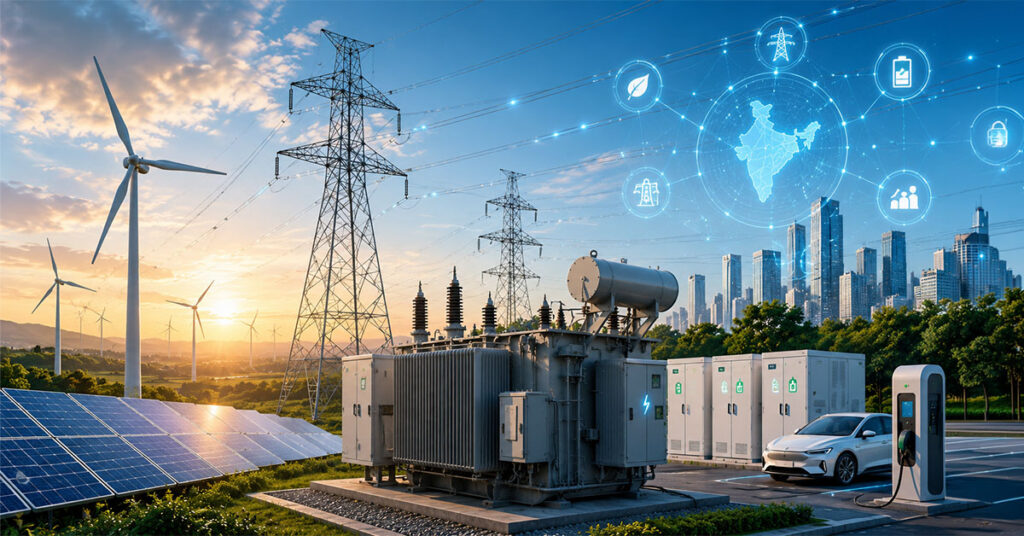
The Government of India has recently extended the deadline for submitting feedback on the Draft National Electricity Policy (NEP) 2026 until March 19, 2026, inviting inputs from stakeholders and the public on the proposed reforms. The proposed Draft National Electricity Policy (NEP) 2026 will replace the existing National Electricity Policy introduced in 2005. The policy has raised debate over its benefits and challenges to the Indian power sector.
The new policy, however, aims to increase India’s per capita electricity consumption to 2,000 kWh by 2030 and more than 4,000 kWh by 2047. From an environmental perspective, the policy seeks to reduce emissions intensity by 45% from 2005 levels by 2030 and support India’s long-term goal of achieving Net Zero India 2070.
Key Proposals in NEP 2026 India
One of the major reforms proposed under NEP 2026 India is the introduction of Resource Adequacy (RA) planning. Under this framework, Distribution Companies (DISCOMs) and State Load Despatch Centres (SLDCs) will prepare utility- and state-level RA plans under State Commission regulations. The Central Electricity Authority (CEA) will consolidate these plans into a national RA plan to ensure planned and reliable capacity expansion.
The draft policy also emphasizes restoring the financial health of the power sector. It proposes indexing tariffs with automatic annual revisions in cases where State Commissions delay tariff orders. In addition, the policy aims to gradually phase out cross-subsidies, ensure cost-reflective tariffs, and establish a predictable open-access surcharge trajectory. As India’s power sector is expected to require approximately ₹50 lakh crore of investment by 2032 and nearly ₹200 lakh crore by 2047 to support expansion across generation, transmission, and distribution infrastructure.
Transmission and Distribution Reforms
In the transmission segment, the policy proposes standardizing competitive bidding for transmission projects, optimizing project execution processes, and streamlining Right-of-Way (RoW) procedures to accelerate infrastructure deployment.
The policy also focuses on strengthening distribution networks by achieving single-digit AT&C Aggregate Technical and Commercial (AT&C) losses, promoting shared distribution networks, establishing Distribution System Operators (DSOs) to enable integration of renewables, energy storage, and Vehicle-to-Grid (V2G) technologies, and ensuring N-1 redundancy in large cities by 2032. It proposes implementing underground distribution networks in congested urban areas.
It also stresses on improving grid governance through State Transmission Utility (STU) unbundling and alignment with the Indian Electricity Grid Code. Additionally, NEP 2026 proposes that Regulatory Commissions may exempt distribution licensees from Universal Service Obligation (USO) for consumers with a contracted load of 1 MW or above.
Energy Storage and Nuclear Energy
Draft National Electricity Policy (NEP) 2026 strongly promotes market-based deployment of energy storage, including Battery Energy Storage Systems (BESS), along with the development of domestic manufacturing capabilities for battery cells and related components.
Draft National Electricity Policy (NEP) 2026 is also aligned with the Sustainable Harnessing and Advancement of Nuclear Energy for Transforming India (SHANTI) Act 2025, which supports adoption of advanced nuclear technologies, development of Small Modular Reactors (SMRs), enabling commercial and industrial consumers to utilize nuclear power and achieving a target of 100 GW of nuclear power capacity by 2047.
Impact of NEP 2026 on transformer industry
The Draft National Electricity Policy (NEP) 2026 is expected to significantly benefit the transformer industry by creating sustained demand for new, advanced, and higher-capacity transformer systems. This demand will be driven by large-scale renewable energy integration, grid strengthening initiatives, and expansion of distribution networks.
The policy’s focus on grid modernization and reliability, including the implementation of N-1 redundancy standards, will require additional transformer capacity and redundancy, particularly in large urban distribution networks.
The strengthening of the national transmission grid and expansion of transmission systems will increase demand for high-voltage (HV) and ultra-high-voltage (UHV) transformers.
Further, to ensure N-1 redundancy at the distribution transformer level in cities with populations exceeding one million by 2032 will require utilities to significantly upgrade and expand their distribution infrastructure.
The proposal to deploy underground networks in congested urban areas and the goal of achieving single-digit AT&C losses will accelerate the replacement of aging transformers with modern, energy-efficient units.
The policy also emphasizes large-scale integration of renewable energy, which requires specialized transformers for solar and wind power plants capable of handling fluctuating loads and variable generation patterns.
Additionally, the shift toward smart grids and integration of Battery Energy Storage Systems (BESS) will generate demand for smart transformers and advanced grid technologies that enhance operational efficiency, monitoring, and grid stability. BESS India is currently increasing with priority for renewable energy.
The long-term target of increasing per capita electricity consumption to more than 4,000 kWh by 2047 will ensure sustained growth in electricity demand, thereby driving long-term expansion of transformer capacity across generation, transmission, and distribution segments.
Challenges Involved
The success of the new Draft National Electricity Policy (NEP) 2026, however, will entirely depend on addressing the following challenges:
- As the policy proposes to reduce Discom losses with the implementation of reversing populist and low-tariff pricing, which may threaten increase in electricity costs.
- The push for 100GW of nuclear power and energy storage measures is capital-intensive, and nuclear power production costs may jump over to around Rs 30 crore per a MW, which is higher than the conventional thermal power.
- The move to slash heavy cross-subsidization may lead to higher tariffs for industries and that can in turn, affect the global competitiveness and the policy also lacks strong built-in stabilization.
About Shirdi Sai Electricals Limited
Shirdi Sai Electricals Limited (SSEL) was founded in the year 1994 at Kadapa in Andhra Pradesh. It was established by Mr N Visweswara Reddy, who currently serves as Chairman and Managing Director (CMD) for the organisation. The organisation was initially served as transformer repair unit, but it has metamorphosed into one of the largest transformer manufacturing companies in India over three decades.
SSEL has grown into reliable energy solutions provide in India and across the world over the last three decades. It currently operates 5 manufacturing facilities with different product portfolio. It manufactures Power and Distribution Transformers. SSEL products are exported to over 40 countries across the world. It has state-of-the-art manufacturing facilities located at Kadapa in Andhra Pradesh, Naini in Uttar Pradesh and Kancheepuram in Tamilnadu.