

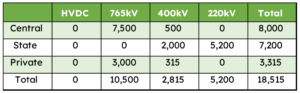
India’s power transmission infrastructure has recorded a strong start to FY27, with the commissioning of 18,515 MVA of new transformation capacity during April–May 2026 across substations rated 220 kV and above.
According to the latest data from the Central Electricity Authority (CEA), the actual capacity addition significantly surpassed the planned target of 12,564 MVA for the period, highlighting the accelerated pace of transmission network expansion.
765 kV Category Leads Growth
The 765 kV voltage class emerged as the key driver of capacity expansion, contributing 10,500 MVA, accounting for over half of the total transformation capacity added during the first two months of FY27.
A major share of this addition came from Power Grid Corporation of India Ltd. (PGCIL), which commissioned 7,500 MVA, while the remaining capacity was contributed by private sector developers. The robust performance highlights the growing importance of ultra-high-voltage infrastructure in supporting India’s expanding electricity network and renewable energy integration.
Transformation Capacity Addition in 2MFY27 (MVA)
Source: CEA.
Boost to Interstate Transmission System (ISTS)
The strong commissioning activity also accelerated the development of the Interstate Transmission System (ISTS). During April-May FY27, 11,315 MVA of new substation capacity was added to the interstate grid, representing more than 60% of the total transformation capacity commissioned during the period.
The expansion of ISTS infrastructure remains critical for enabling efficient power transfer across regions and supporting the country’s renewable energy ambitions.
Mixed Performance Across Voltage Segments
While the 765 kV segment exceeded expectations, the 400 kV category underperformed. Against a planned addition of 4,815 MVA, only 2,815 MVA was commissioned. Both PGCIL and private sector developers fell short of their targets in this voltage class.
In contrast, the 220 kV/230 kV category delivered a strong performance, with 5,200 MVA added during the period, significantly exceeding the planned 3,249 MVA. Notably, the entire addition in this category was achieved by the state government sector.
FY27 Outlook
For the full financial year FY27 (April 2026–March 2027), India has set an ambitious target of 158,339 MVA of new transformation capacity. The 765 kV and 400 kV segments are expected to play a pivotal role in achieving this goal, particularly through projects focused on strengthening interstate transmission infrastructure.
As power demand continues to rise and renewable energy capacity expands, sustained investments in high-voltage transmission networks will remain essential to ensuring grid reliability, efficiency, and long-term energy security.