


The Central Electricity Authority (CEC) has issued a standardised set of timelines for power transmission projects aimed at improving coordination between generation projects transmission networks, and last-mile distribution infrastructure. The move is expected to reduce delays that often leave newly commissioned power generation capacity awaiting grid connectivity.
As India accelerates the integration of renewable energy into its power system, the initiative is expected to strengthen project planning and enhance the efficiency of the country’s transmission network.
At its recent 4th meeting, the National Committee on Transmission (NCT) approved the adoption of standardized timelines for various configurations of Inter-State Transmission System (ISTS) projects.
The timelines vary according to voltage level, project configuration, and route length. For example, a 765kV double-circuit transmission line exceeding 100 km has been assigned a completion period of 36 months, while a 400kV double-circuit line shorter than 50 km is expected to be completed within 24 months. Capacity augmentation works at existing substations have generally been allocated timelines ranging from 24 to 30 months.
The timelines set by CEC are as Follows:
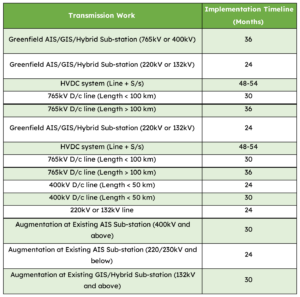
The timelines for transmission lines depend on their voltage level, configuration, and route length. For instance, a 765kV double-circuit transmission line exceeding 100 kilometers has been given a completion period of 36 months. In comparison, a 400kV double-circuit line shorter than 50 kilometers is expected to be completed within 24 months. Capacity augmentation works at existing substations have generally been assigned timelines ranging between 24 and 30 months.
Extra Time Allowed in Difficult Terrain
Recognizing the challenges of executing infrastructure projects in difficult geographical regions, the CEA has provided flexibility for projects located in the North East, Sikkim, Jammu & Kashmir, Ladakh, and Himachal Pradesh. Such projects may receive an extension of 6 to 12 months, depending on local conditions and project complexity.
For transmission schemes comprising multiple components, the timeline applicable to the component with the longest execution period will govern the overall project schedule.
The CEA has advised generation companies, transmission developers, distribution companies (DISCOMs), and bulk consumers to align equipment procurement, financial closure, and construction activities with the prescribed timelines.
The guidance comes at a time when renewable energy capacity additions are growing rapidly, while transmission infrastructure development often takes longer to complete. This mismatch can delay grid connectivity for commissioned renewable energy projects.
By establishing uniform implementation schedules, the new framework is expected to improve coordination between power generation and network development, facilitate timely project execution, and support India’s transition to a cleaner and more reliable energy system.