
Indian Transmission Sector Set for FY27 Turnaround
India transmission sector is poised for a significant turnaround by FY27, marking the end of nearly five years of subdued performance. According to a recent report by SBI Caps, the sector presents a massive ₹7.6 trillion investment opportunity over the next six years, driven by rising electricity demand and the rapid expansion of renewable energy. After a prolonged period of delays and missed targets, early signs of recovery have begun to emerge in FY26, indicating that the sector may finally be entering a phase of sustained growth. India transmission sector is heading towards a sustained growth after prolonged slow down, and this time the growth trajectory has been positive.
A Phase of Prolonged Slowdown
Over the past few years, Indian power transmission sector has struggled to meet expansion targets, resulting in slower infrastructure growth and delays in strengthening the national grid.
One of the primary challenges has been right-of-way (RoW) issues and land acquisition hurdles. Securing transmission corridors often involves complex negotiations with multiple stakeholders, particularly in densely populated and environmentally sensitive regions. These challenges have led to project delays and cost escalations.
Regulatory complexities have further compounded the problem. Lengthy environmental clearance processes, evolving compliance requirements, and restrictions in ecologically sensitive areas have extended project timelines and created uncertainty for developers and investors.
In addition, global supply chain disruptions have impacted the availability of critical equipment such as transformers, conductors, and high-voltage components. Dependence on imports for certain technologies exposed the sector to volatility in global markets, increasing both project costs and execution risks.
Signs of Recovery Emerging
Despite these headwinds, FY26 has shown encouraging progress. Transmission line additions have improved significantly, and substation capacity expansion is gradually aligning with planned targets. This reflects better coordination among stakeholders, improved execution capabilities, and a more supportive policy environment.
However, targets under the National Electricity Plan (NEP) for March 2027 may still be missed, indicating that while recovery is underway, challenges persist.
₹7.6 Trillion Investment Opportunity
A key highlight of the sector’s outlook is the emergence of a ₹7.6 trillion investment pipeline over the next six years. This includes both delayed projects and new infrastructure required to support future demand.
India’s electricity demand is expected to grow at 6–6.5% annually, while the country targets over 600 GW of renewable energy capacity by 2032. This will require a significant scale-up in transmission infrastructure, with the pace of network expansion needing to more than triple current levels.
Renewable Energy Driving Transmission Demand
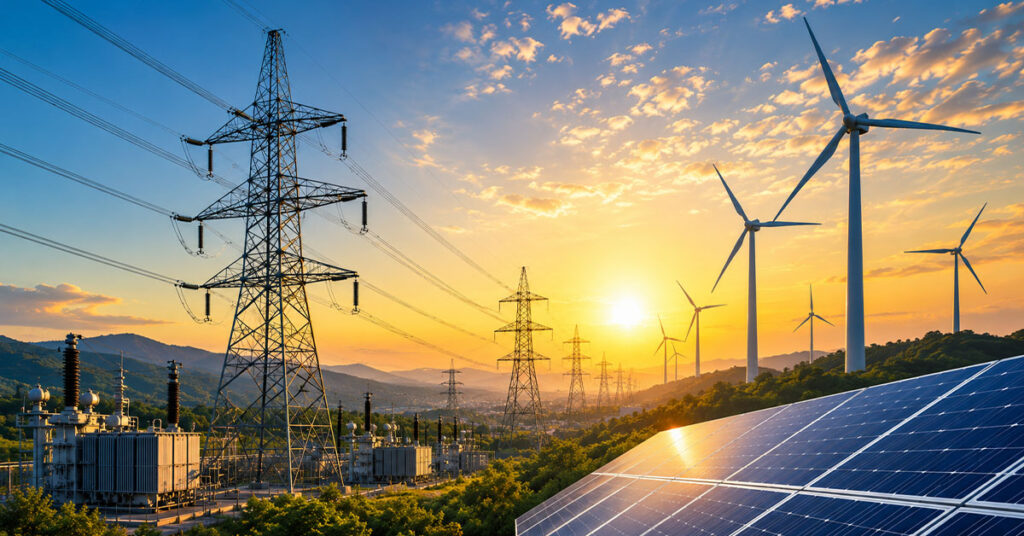
The rapid growth of solar and wind energy is expected to be a major catalyst for transmission expansion. As renewable generation increases, the need for a strong and flexible grid becomes critical.
Transmission networks will play a vital role in connecting renewable energy hubs to consumption centers, ensuring efficient power evacuation and grid stability. Without adequate transmission capacity, renewable integration could face bottlenecks.
India power transmission market has been witnessing surge recently due to impetus from renewable energy sector push in the country.
Transmission infrastructure India has been increasing year-on-year with demand surge for all sources of energy.
Policy Shifts Reshaping the Sector
Recent regulatory changes are likely to significantly influence transmission demand and investment patterns. The phased withdrawal of Inter-State Transmission System (ISTS) charge waivers for renewable projects may discourage long-distance power transmission.
This is expected to encourage states, especially those rich in solar resources, to develop more localized generation capacity. As a result, investment is likely to shift toward intra-state transmission networks, improving project viability at the state level.
Storage as a Game-Changer
Energy storage systems, particularly Battery Energy Storage Systems (BESS), are emerging as a critical solution for grid management.
Co-located storage can help reduce transmission congestion, smooth power flows, and enable better utilization of existing assets. By shifting renewable energy across time, storage solutions can lower the need for additional high-capacity transmission infrastructure while improving overall system efficiency.
Capital Flows and Monetisation Push
To support the sector’s expansion, innovative financing mechanisms are gaining traction. The government has set a ₹2.3 trillion target under the National Monetisation Pipeline (NMP) 2.0 for transmission assets between FY26 and FY30.
Models such as Build-Own-Operate-Transfer (BOOT) and Infrastructure Investment Trusts (InvITs) are expected to play a crucial role in unlocking capital and enabling asset recycling. However, challenges such as limited asset availability and leverage constraints remain.
State-Level Opportunity: The Next Frontier
State-owned transmission networks represent a significant untapped opportunity, with an estimated ₹2.9 trillion monetisation potential. These networks account for nearly 90% of intra-state transmission systems.
Unlocking this potential will require regulatory consistency, timely tariff orders, and structural reforms such as unbundling assets into special purpose vehicles (SPVs). Even partial monetisation could significantly improve capital availability and accelerate infrastructure development.
Challenges That Remain
While the outlook is positive, certain risks continue to pose challenges:
- Execution delays due to land acquisition and RoW issues
- Regulatory uncertainties and evolving policy frameworks
- Supply chain dependencies for critical equipment
- Financing and monetisation bottlenecks at the state level
Addressing these issues will be critical to sustaining long-term growth.
Outlook: Entering a Multi-Year Growth Cycle
India’s transmission sector is at an inflection point. With strong policy support, rising demand, and a clear push toward renewable energy integration, the sector is well-positioned for a multi-year growth cycle.
Although near-term challenges may persist, FY27 is likely to mark the beginning of a more resilient, efficient, and investment-driven transmission ecosystem, one that will be central to India’s clean energy transition and long-term economic growth.
About Shirdi Sai Electricals Limited
Shirdi Sai Electricals Limited (SSEL) was founded in the year 1994 at Kadapa in Andhra Pradesh. It was established by Mr N Visweswara Reddy, who currently serves as Chairman and Managing Director (CMD) for the organisation. The organisation was initially served as transformer repair unit, but it has metamorphosed into one of the largest transformer manufacturing companies in India over three decades.
SSEL has grown into reliable energy solutions provide in India and across the world over the last three decades. It currently operates 5 manufacturing facilities with different product portfolio. It manufactures Power and Distribution Transformers. SSEL products are exported to over 40 countries across the world. It has state-of-the-art manufacturing facilities located at Kadapa in Andhra Pradesh, Naini in Uttar Pradesh and Kancheepuram in Tamilnadu.