
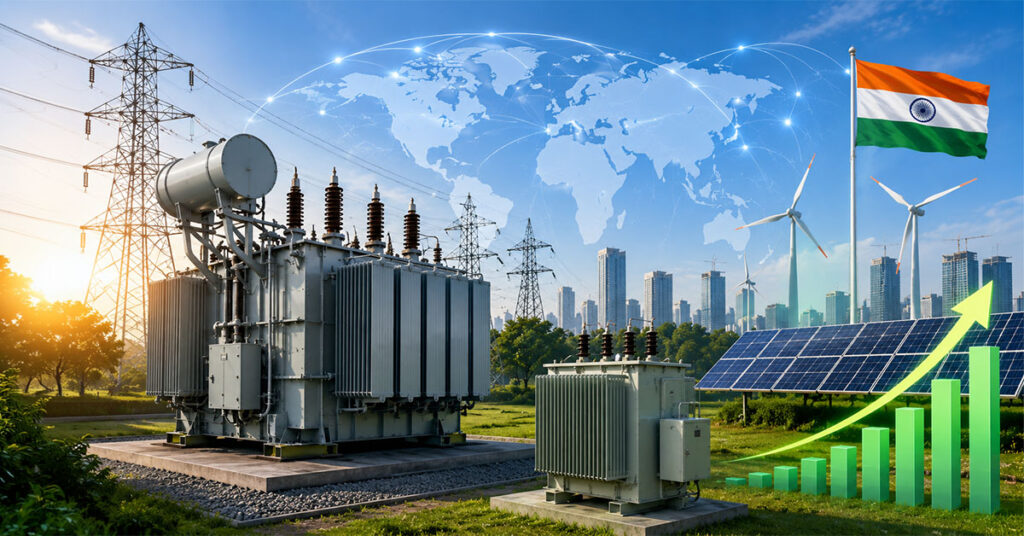
World Transformer Market: India’s Position and Outlook
The global transformer market is overwhelmingly dominated by China, which accounts for more than half of the world’s production capacity. Recent industry estimates indicate that China’s total output exceeded $43.54 billion in 2025. The United States, Germany, Japan, and South Korea also rank among the top five countries supplying transformers to the global market.
China leading the global transformer market
China’s leadership in the transformer sector is underpinned by its highly integrated and vertically aligned supply chain. From critical raw materials such as electrical steel, copper, and aluminium to advanced components including cores, windings, and on-load tap changers, the country has built a comprehensive ecosystem. This enables unparalleled scale, faster production cycles, and significant cost efficiencies, reinforcing its dominant position in the global transformer market. The Chinese transformer industry generated approximately $9.3 billion in 2025, with average unit prices rising by nearly one-third to around 205,000 yuan, driven by tightening global supply and persistent shortages.
By 2028, China targets energy-efficient transformers to comprise over 75% of all new installations. In parallel, such high-efficiency units are projected to account for around 15% of the existing installed base, according to a recently released plan by the Ministry of Industry and Information Technology along with other central authorities.
Global transformer market has been evolving over the years with the rising demand from renewable energy and AI data centers.
Factors boosting global transformers demand
The global transformer market is experiencing an unprecedented surge in demand, driven by multiple structural and technological shifts reshaping the power sector worldwide. Rapid expansion of AI-driven data centers, accelerated renewable energy integration, grid modernization initiatives, and widespread electrification are collectively fueling this growth. As a result, supply chains are under significant strain, with high-voltage and substation transformers facing lead times of over two years and supply shortfalls reaching up to 30% in key markets such as the United States and Europe.
One of the primary demand drivers is the rise of AI and hyperscale data centers, which require high-capacity substation and generator step-up transformers to support massive, continuous power loads. This has created a new layer of sustained, high-intensity demand for advanced transformer solutions.
At the same time, aging grid infrastructure is accelerating replacement cycles. Many transformers installed decades ago are approaching the end of their operational life, while increasing exposure to extreme weather events is pushing utilities to invest in more resilient and reliable equipment.
Electrification trends are also playing a crucial role. The rapid growth of electric vehicle charging networks, industrial reshoring, and ongoing urbanization are significantly increasing electricity consumption, thereby amplifying the need for robust transmission and distribution infrastructure.
Together, these factors are creating a strong, long-term demand outlook for the global transformer market, while also highlighting the urgent need for capacity expansion and supply chain strengthening within the industry.
Indian Transformer industry
India’s transformer market is currently valued at $2.6 billion in 2025 and is projected to grow to approximately $5.6 billion by 2034, registering a CAGR of 7–8%.
The market broadly comprises three key segments:
- Power transformers (above ~5 MVA), used in transmission networks
- Distribution transformers (up to ~5 MVA), catering to last-mile electricity delivery
- Special transformers, including applications such as traction, furnace, and renewable energy
This segmentation reflects the diverse and evolving demand across transmission, distribution, and specialized industrial and clean energy applications.
India transformer market has been on the rise with the increase in demand from both renewable and conventional power sectors.
India is one of the fastest-growing markets for transformer manufacturing, with over 300 players spanning both organized and unorganized segments.
The India transformer market is projected to reach around $4.4 billion by 2033, while Distribution transformer market continue to account for a significant share of the overall market. This growth is largely driven by rural electrification initiatives and rapid urban expansion.
However, the industry remains highly fragmented, particularly in the distribution transformer segment, where numerous small and mid-sized manufacturers operate alongside established players.
What is hindering India transformer market?
Despite steady growth in India’s transformer market, several structural and operational challenges are constraining its full potential.
A key concern is the widening gap between demand and supply. Rapid expansion in renewable energy, urbanization, and data centers has significantly increased demand for transformers, while supply has struggled to keep pace, leading to longer lead times and project delays.
Rising input costs are another major issue. Prices of critical raw materials such as CRGO (cold-rolled grain-oriented steel) and copper have surged, increasing overall transformer costs. This challenge is compounded by India’s heavy reliance on imports for electrical-grade steel and specialized insulation materials, exposing the industry to global price volatility and supply risks.
The weak financial health of power distribution companies (DISCOMs) continues to be a structural bottleneck. Persistent delays in payments strain manufacturers’ working capital, disrupt order cycles, and limit their ability to scale operations efficiently.
India’s aging and inefficient grid infrastructure further aggravates the situation. A large number of transformers in operation are outdated, overloaded, and poorly maintained. This results in high transmission and distribution (T&D) losses, frequent equipment failures, and reduced system efficiency.
Transformer supply chain disruptions have also emerged as a critical challenge. Shortages of key components, logistics delays, and a limited vendor ecosystem are slowing project execution and leading to backlog accumulation across EPC projects.
Additionally, manufacturing and capacity constraints are hindering growth. Transformer production is capital-intensive and technologically demanding. Expanding capacity requires significant investment and time, while the industry also faces shortages of skilled labor, further slowing scalability.
About Shirdi Sai Electricals Limited
Shirdi Sai Electricals Limited (SSEL) was founded in the year 1994 at Kadapa in Andhra Pradesh. It was established by Mr N Visweswara Reddy, who currently serves as Chairman and Managing Director (CMD) for the organisation. The organisation was initially served as transformer repair unit, but it has metamorphosed into one of the largest transformer manufacturing companies in India over three decades.
SSEL has grown into reliable energy solutions provide in India and across the world over the last three decades. It currently operates 5 manufacturing facilities with different product portfolio. It manufactures Power and Distribution Transformers. SSEL products are exported to over 40 countries across the world. It has state-of-the-art manufacturing facilities located at Kadapa in Andhra Pradesh, Naini in Uttar Pradesh and Kancheepuram in Tamilnadu.